
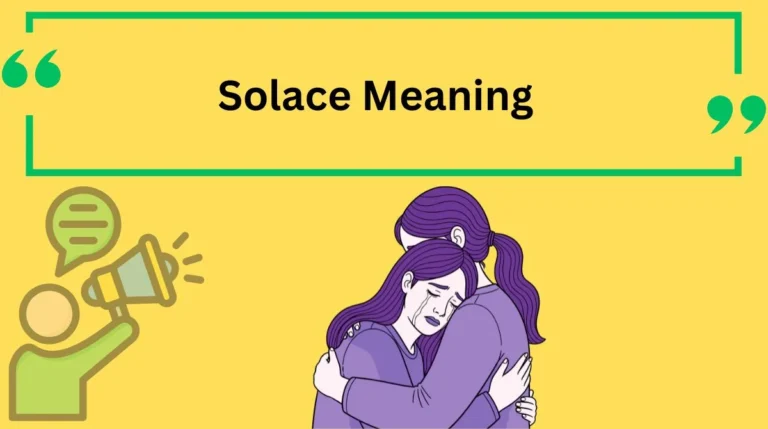
The phrase solace meaning is commonly searched by people who want to understand emotions, language, and human connection more deeply.
The word solace appears often in conversations about comfort, healing, and emotional support, especially during stressful or sad moments.
Many people encounter it in books, quotes, messages, or social media captions and want a clear, simple explanation.
Understanding the solace meaning helps you communicate empathy, respond thoughtfully, and express emotional understanding. It also helps avoid confusion when the word is used in professional writing or online conversations.
In today’s digital world, words that express comfort have gained renewed importance, particularly in chats, dating apps, and mental-health discussions.
This guide explains what solace means, where it comes from, how it’s used today, and how it differs from similar words—all in clear, easy-to-read language.
Meaning & Definition of Solace
The solace meaning centers on comfort and emotional relief. At its core, solace refers to something that eases sadness, pain, or distress. It can be emotional, mental, or even physical, depending on the situation.
Primary Meaning
Solace means comfort during times of sorrow, disappointment, or emotional pain. It often comes from people, words, memories, or activities.
Examples:
- Finding solace in music after a hard day
- A friend offering solace after bad news
- Reading a book for solace during grief
Secondary Meaning
Solace can also refer to the act of giving comfort, not just receiving it.
Examples:
- She tried to solace him with kind words
- He found ways to solace others through volunteering
Quick Examples
- Emotional solace from loved ones
- Mental solace through meditation
- Quiet places offering solace
In simple terms, if something makes you feel calmer, safer, or less sad, it provides solace.
Background & Origin of the Word Solace
Understanding the background of the solace meaning gives the word more emotional depth. Solace comes from the Latin word solari, which means to comfort or soothe. Over time, it passed into Old French as solas, and later into Middle English as solace.
Historically, the word was often used in poetry, religion, and philosophy. Writers used it to describe inner peace during hardship, especially in times of loss or suffering. Religious texts frequently referred to solace as spiritual comfort granted during trials.
In earlier centuries, solace was closely tied to moral and emotional strength. People believed finding solace helped maintain dignity and hope during difficult periods. As language evolved, the word became more widely used in everyday conversation.
Today, the word still carries its original emotional weight, but it has become more accessible and commonly used in digital communication, therapy discussions, and personal storytelling.
Usage in Different Contexts
The solace meaning changes slightly depending on context, though the emotional core remains the same.
Everyday Conversation
- “Music gives me solace.”
- “She found solace in nature.”
Professional & Formal Writing
- Used in psychology, counseling, and wellness content
- Appears in speeches, articles, and reflective essays
Creative Writing
- Poetry and novels use solace to convey deep emotion
- Often linked with healing, grief, or reflection
Religious & Spiritual Use
- Refers to spiritual comfort
- Common in sermons and motivational texts
Across all contexts, solace always implies relief from emotional difficulty.
Meanings Across Platforms
The solace meaning stays consistent but adapts to platform tone.
WhatsApp & Text Messages
- Used to express empathy
- Often paired with emotional support
- Seen in captions about healing or self-care
- Common in mental health posts
TikTok
- Used in storytelling and emotional videos
- Often appears in motivational content
Snapchat
- Less common, but used in reflective snaps
Short examples:
- “Late-night walks are my solace.”
- “Art became her solace.”
Other Fields & Technical Meanings
While the solace meaning is primarily emotional, it may appear metaphorically in other fields.
- Medical/Psychology: Emotional solace for patients
- Technology: Used metaphorically in UX writing
- Aviation/Physics: No formal technical definition
Important note: Solace is not a scientific or technical term by definition. Any technical use is symbolic, not literal.
Common Misconceptions & Mistakes
Many misunderstand the solace meaning. Common errors include:
- ❌ Thinking solace means happiness
- ❌ Confusing solace with distraction
- ❌ Using it for minor comfort
Solace implies deep emotional relief, not casual enjoyment.
Similar Terms & Alternatives
| Word | Meaning | Difference |
|---|---|---|
| Comfort | Ease or relief | Broader, less emotional |
| Relief | Removal of pain | Often temporary |
| Consolation | Sympathy | External support |
| Peace | Calm state | Not always emotional |
How to Respond to “Solace” in Chat
When someone mentions solace, respond with empathy.
Examples:
- “I’m glad you found something that brings you peace 💙”
- “That sounds comforting, honestly 😊”
- “Everyone needs their own form of solace sometimes.”
Differences From Similar Words
- Solace vs Comfort: Solace is deeper
- Solace vs Relief: Solace lasts longer
- Solace vs Distraction: Solace heals
Relevance in Online Conversations & Dating Apps
On dating apps, the solace meaning often signals emotional depth.
Examples:
- “Music is my solace.”
- “I find solace in deep conversations.”
It suggests sensitivity, introspection, and emotional awareness.
Popularity & Trends Over Time
Search interest in solace meaning has increased due to:
- Mental health awareness
- Emotional openness online
- Social media storytelling
Google Trends shows steady growth, especially during global crises and wellness movements.
FAQs & Related Search Queries
1. What does solace mean in simple words?
It means comfort during sadness or pain.
2. Is solace a positive word?
Yes, it has a comforting and healing meaning.
3. Can a person be a solace?
Yes, people can provide solace.
4. Is solace emotional or physical?
Mostly emotional, sometimes mental.
5. How is solace used in a sentence?
“I found solace in writing.”
Conclusion
Understanding the solace meaning helps you express empathy, emotional intelligence, and understanding in both personal and digital conversations.
Solace represents comfort during difficult moments and reminds us that healing often comes from simple things—words, people, or quiet experiences. Whether used in writing, chats, or social media captions, solace carries emotional depth and sincerity.
In a fast-moving digital world, words like solace help slow things down and reconnect us to genuine human emotion. Knowing how and when to use it allows for more meaningful communication and emotional clarity.